How roulette actually works
Roulette is the clearest demonstration of fixed odds ever built, which is why it is worth understanding even if you never play it. Every bet on the table is priced from the same single fact: there are 37 pockets, and only 36 of them are paid for.
There is no roulette table at Maple Play Room
This page is a guide, not a game. The four games in this room are Vault Circuit, Canopy Dice, Midway Draw and Runeclimb. Roulette is here because it explains the idea of a house edge better than anything else, and that idea sits underneath all four of them.
The wheel
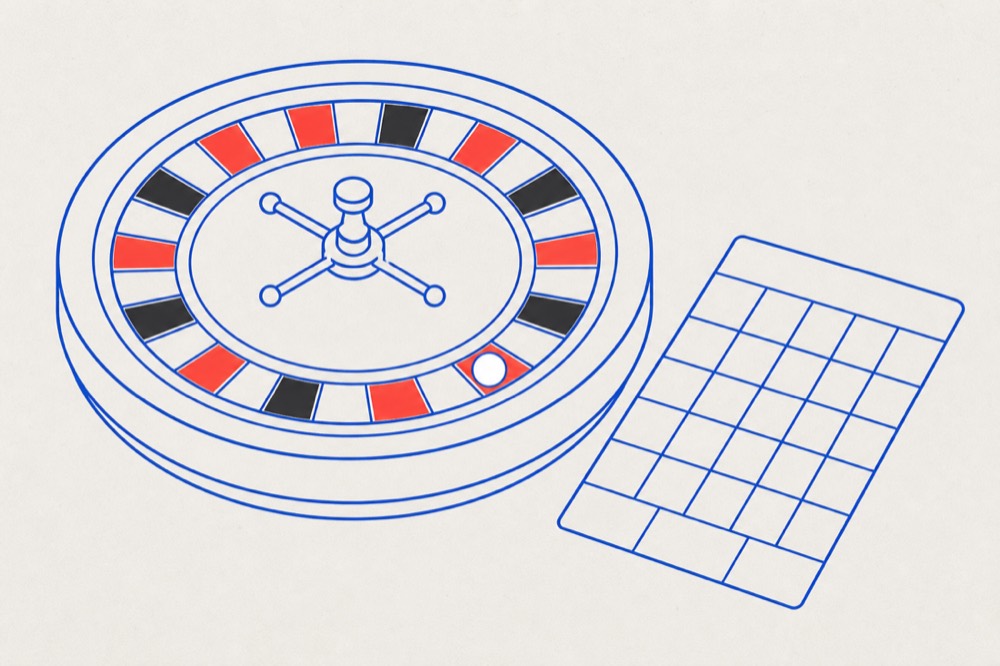
A European wheel has 37 pockets: the numbers 1 to 36, plus a single green zero. Eighteen of the numbers are red and eighteen are black. The ball is spun against the direction of the wheel and settles in one pocket, and every pocket is equally likely.
The order around the rim is not sequential. It runs 0, 32, 15, 19, 4, 21, 2, 25, 17, 34, 6, 27, 13, 36, 11, 30, 8, 23, 10, 5, 24, 16, 33, 1, 20, 14, 31, 9, 22, 18, 29, 7, 28, 12, 35, 3, 26 — and then back to zero. Read the colours as you go and they alternate red, black, red, black without a single break, which is the arrangement the layout is designed around.
The American wheel adds a double zero for 38 pockets. It looks like a small change and is not: it nearly doubles the cost of playing, which is why the single-zero wheel is the one worth learning.
What each bet pays and how often it lands
The figures below are for a single-zero wheel. Notice the last column: it is identical all the way down, which is the entire trick of the game.
| Bet | Numbers covered | Pays | Chance | House edge |
|---|---|---|---|---|
| Straight up | 1 | 35 to 1 | 2.70% | 2.70% |
| Split | 2 | 17 to 1 | 5.41% | 2.70% |
| Street | 3 | 11 to 1 | 8.11% | 2.70% |
| Corner | 4 | 8 to 1 | 10.81% | 2.70% |
| Six line | 6 | 5 to 1 | 16.22% | 2.70% |
| Column or dozen | 12 | 2 to 1 | 32.43% | 2.70% |
| Red or black | 18 | 1 to 1 | 48.65% | 2.70% |
| Odd or even | 18 | 1 to 1 | 48.65% | 2.70% |
| 1–18 or 19–36 | 18 | 1 to 1 | 48.65% | 2.70% |
Where the 2.70% comes from
Cover any group of numbers and the payout is calculated as though the wheel had 36 pockets. Bet on one number and you are paid 35 to 1, which would be exactly fair on a 36-pocket wheel. The wheel has 37. That single extra pocket is the entire house edge: 1 ÷ 37 = 2.70%, and it applies identically to every bet on the layout, from a single number to red.
Two rules worth knowing
Some tables apply la partage to even-money bets: when the ball lands in zero, half the stake is returned instead of the whole stake being lost. That halves the edge on those bets to 1.35%. A related rule, en prison, leaves the stake on the table for one more spin rather than returning half of it, and works out to much the same thing.
Neither rule applies to any other bet, and neither rule exists on most tables. When they do, they make red or black the best-value bet in the building.
Why systems do not work
The most famous is the Martingale: double your stake after every loss, so the first win recovers everything. It fails for two reasons that have nothing to do with luck. Stakes grow geometrically — eight losses in a row turns a small unit into 256 of them — and every table has a maximum. The system does not change the odds of any spin, only how quickly a balance moves.
The deeper problem is the assumption underneath it. A wheel that has landed red eight times running is exactly as likely to land red again as it was the first time. The wheel has no memory, no fatigue and no sense of balance. That instinct is so common it has a name — the gambler's fallacy — and it costs more money than any other idea in the building.
Five things that are always true
- Every pocket is equally likelyIncluding zero, and including the number that has just come up twice.
- Every European bet costs the same2.70%, whether you cover one number or eighteen.
- Zero is not black or redEven-money bets lose to it unless la partage applies.
- The scoreboard tells you nothingThose screens of recent results exist to encourage betting, not to inform it.
- Two zeros doubles the costAn American wheel takes 5.26% instead of 2.70%, and 7.89% on its five-number bet.